Bladelius Miner €3.000

- 2 pc Toslink input
- 2 pc spdif input
- 1 pc analog input
- 2 pc USB
- 1 USB togo
- Analog input
- Headphone out
- Pre out
- Ethernet
- Wifi
- Supports 32bit/384khz
CD player optional
Plays from WIMP, Spotify, Nas, USB Etc
iPad App released soon.

| dac | computer audio | audiophile equipment |


| Streaming Client formats | MP3 , WMA, AAC, OGG-Vorbis, FLAC (192/24 via LAN) and WAV (192/24 via LAN) with gapless playback (where supported by server) | |
| Supported media servers | UPnP AV, Microsoft Windows Player 10, (MS DRM 10), vTuner Internet Radio Service, DLNA compatible servers | |
| Features | Web server (remote PC web browser control), Audio network config., Internet Radio Station database (automatic update via Internet) digital access of iPod contents (D/A conversion in MP 1260 R) | |
| Interfaces | USB 2.0, iPod with control and display, 2 x Digitalentrances (SP/DIF) coax + optical (TOS-Link), 16 ... 24 Bit, 24 ... 96 ks/S, LAN, W-LAN | |
| Audio data | ||
| Analogue outputs | Stereo 2,5 Veff / 22 Ohm | |
| Digital outputs | 1 x coax IEC 60958 (LPCM) | |
| D/A converter | 32 Bit, 352,8/384 kHz Sigma Delta 8-times oversampling | |
| Upsampling | free programmable signal processor with 4 selectable oversampling algorithms. FIR short, FIR long, Bezier/IIR, Bezier | |
| Analogue filters | Phase linear bessel filter with 100 kHz limit frequency | |
| Frequency response | 2 Hz - 20 kHz | |
| Total harmonic distortion | < 0.001 % | |
| Signal / noise ratio | 112 dB | |
| Channel separation | 106 dB | |


| dlna 1.5 Certified (AUDIO ONLY) |
| Windows 7 Certified |
| Apple AirPlay Certified |
| USB iPod Direct/Flash/HDD |
| Made for iPod/Works with iPhone Certified |
| RadioDenon.com - access to over 12,000 Internet Radio Stations |
| Pandora Radio Streaming |
| Rhapsody and Napster Streaming Price: US$499.99 |


"The new Reference Line Music Server convinces not only by its excellent sound quality, but also by the extremely fast processing of even very large data sets. The local player is both about the device, via the web browser, and via handheld devices such as iPad with a specially developed Burmester Darfur app to be controlled.Streaming over WLAN is also possible. On the integrated drive slot, an existing CD collection in the highest possible quality to rip it. Were not deposited album art and track information are added automatically to a comparison with the database. Due to the forward error correction (FEC) of only a few seconds for audio CD drives, there is the possibility that older or scratched CD went to an audio data stream that includes sporadic dropouts. Without appropriate countermeasures can thus reduce the noise listening."


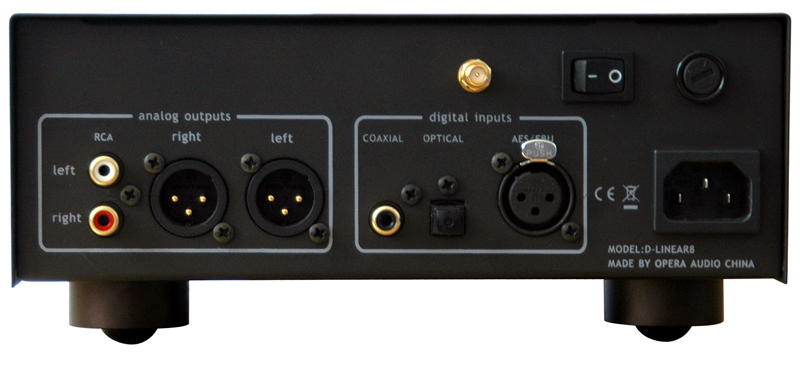


The Classe CP-800 Stereo Preamplifier/Processor is said to be the first of a new generation of stereo preamplifiers designed to take full advantage of today's high resolution digital sources. The CP-800 offers new digital processing features including optimal asynchronous USB and full support of Apple's iPod®, iPhone® and iPad® range of products.
In addition to accommodating legacy analog and digital sources, Classe announced that the CP-800 can also optimize playback from computer audio files and portable devices like iPods via USB using asynchronous techniques and proprietary clocking circuits. A storage device like an iPod or computer can contain all the data of the original recording, so it has the potential to be an audiophile source. The challenge is to clock that data into the D-to-A converters at precisely the right time, which the CP-800 achieves through newly-developed recovery and clocking technology.
A new power supply design optimizes the electrical environment for the audio circuitry inside the CP-800 and benefits associated equipment sharing the same AC power. PFC (Power Factor Correction) technology ensures the most efficient operation of the power supply while maintaining a constant load on the AC Mains. The benefit, according to Classe, is that the preamp/processor does not modulate the AC mains as would a conventional linear power supply without PFC. Other system components won't even know it's there.
In addition to superb performance as a digital-to-analog converter and stereo preamplifier, Classe says the CP-800 boasts features like bass management and parametric EQ that heretofore have been lacking in stereo preamps. There is a subwoofer output and two configurable auxiliary channels that can be used to drive additional subs, bi-amp the L&R channels or feed into another room.
Classe points out that a properly implemented subwoofer (or two) is at least as beneficial to stereo playback systems as it is to home theaters. Placing the Left and Right speakers for best stereo imaging rarely delivers ultimate bass response at the listening position, no matter how well those speakers can reproduce low frequencies. One or more subwoofers avoid this compromise. Parametric EQ enables further tweaking of the low frequency modes to achieve the best overall system performance. As with Classe SSPs, the subwoofer(s) may be configured for use with some inputs and not others or engaged with different crossover frequencies/slopes as desired.
An updated 16x9 touchscreen and graphical user interface give the CP-800 a fresh new look to match its advanced feature set.


"....I analysed over 25 schematics and I reached the conclusion that all these player's digital trace and all schematics of outputs look bad. Some of them better than others, some - so-so, and some just plain bad.
What particularly annoyed me is that the signal trace is so sensitive to small changes of the load - resistance, capacitance and inductance. That's why digital cables sound different from one another - because the transmitter is not optimized. It is weak. Its output impedance is 10 times too high or even more.
if all the problems which distort the signal on the way to the DAC are arising from too weak generator, why not make what an engineer should and add a buffer. The chip will be happy working into virtually no load at all, just the grid. The square will be perfect as hell. Then the tube will have infinitely better output impedance (single hundreds of Ohms) and it will send the signal nice, pure, sharp , stiff and indifferent to cable and plugs. The quality means sending a proper signal not deploying voo-doo and mythology.
I took the tube which is good for high frequencies - the Russian 6N14P, which has a frequency response good till 200 MHz. Our signal needs circa 20 MHz bandwidth so the tube is ten times "too good" for the job. Any other radio tube is good, The parameters like amplification etc. do not matter because it is a cathode follower. The audio tubes are no good because the frequency range is too low.
The resulting square wave is PERFECT. It beats the stock signal without sweat. The difference on the scope is night and day. There is no ringing, no roll off, all is just excellent. I have yet to see the output trace as clean as this one! The MR super clock also helps reducing jitter - data timing problems, as well as it eliminates the high frequency modulations of signals, power supplies and earth in the player...."
Tapping of signal to output tube buffer Credit:Lukasz Fikus
 |
| Before Digilampization Credit: Lukasz Fikus |
 |
| After Digilampization Credit Lukasz Fikus |


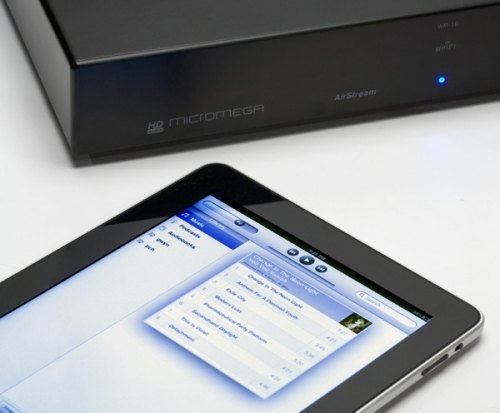
The WM-10 is basically a souped-up Airport Express but they call it "Airstream". It has basically the same specs and functions except the aluminum case (black or silver) and better power supply (R-core transformers rather than switching PSU). Although it uses the Cirrus Logic 4344 24-bit/192hKz DAC (same with the AE), the streaming is limited to 16-bit 44.1/48kHz files due to Airplay limitations. Another limitations is that no matter what file you choose to play, the WM-10 will convert to Apple Lossless (ALAC) on the fly (same as the AE). Retails for $1,595.


